


Date: 9 October 2026
Reading time: 13 minutes
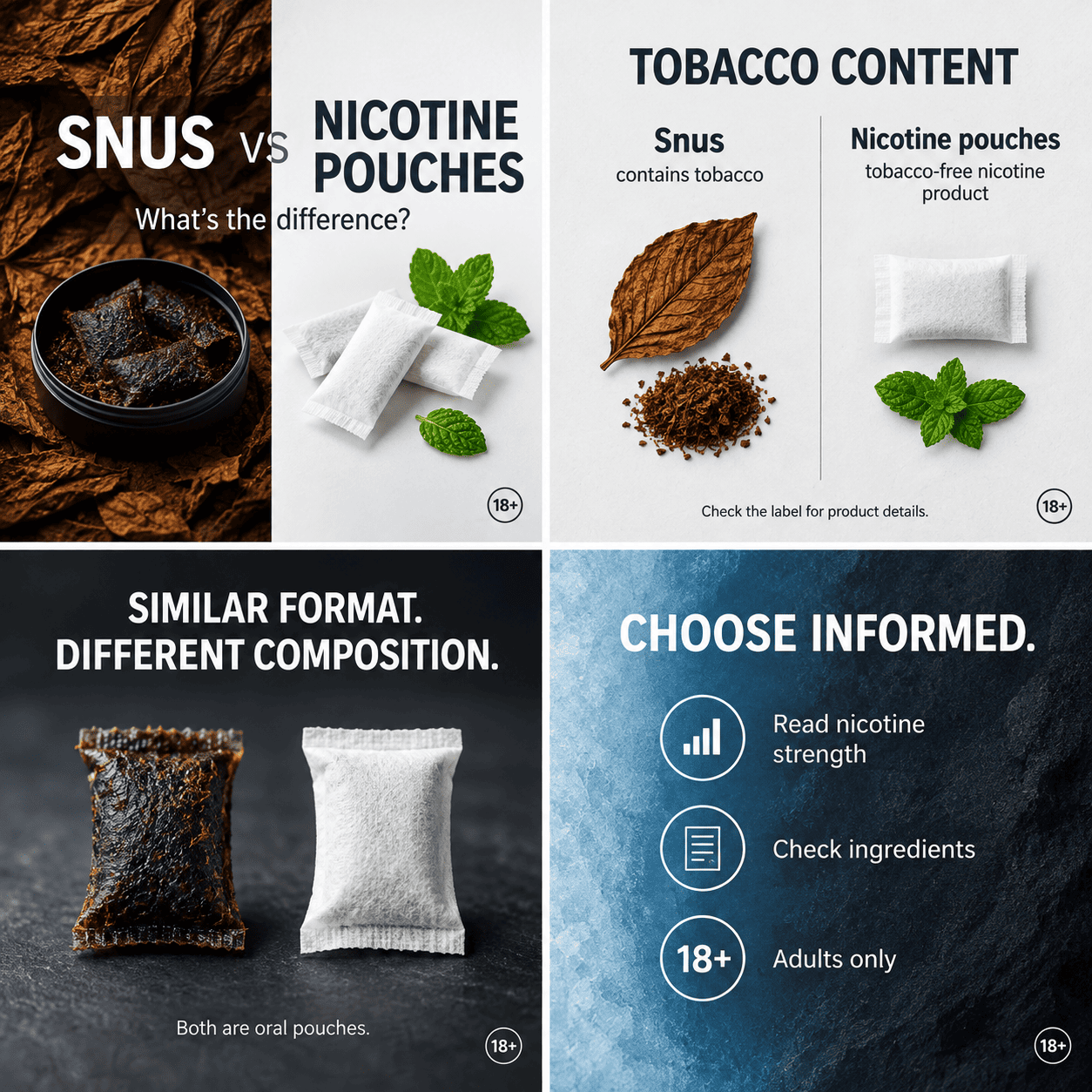
Snus is moist oral tobacco in a small pouch, or sometimes loose, placed under the upper lip. Nothing is lit. Nicotine pouches are a different product: tobacco-free, with nicotine and flavour in a plant-fibre pouch. Search often treats the two words as one. The law, the ingredients, and the Snupax catalogue do not.
What snus is
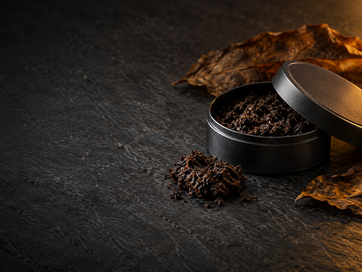
The filling is ground tobacco, water, and salt, often with a humectant and flavour. Nicotine and flavour pass through the lining of the mouth. Unlike some cut chewing tobaccos, there is no need to spit.
That is the product the word meant in Sweden, where it is still part of everyday use, and the product EU law still treats as tobacco for oral use. A round plastic can is the usual pack. Many traditional cans have a second compartment in the lid for used portions. The tobacco itself is brown. The taste is tobacco first, then whatever flavour was added.
Snuff is a third thing, and the similar name causes mix-ups. Snuff is a dry powdered tobacco taken through the nose. It is not placed under the lip. Chewing tobacco is oral too, but it is coarser leaf that is chewed. Snus is neither of those.
Snus and nicotine pouches
In search, "snus" has become the word for anything that goes under the lip. On a product card the difference is sharp.
| Traditional snus | Nicotine pouch | |
|---|---|---|
| Filling | Moist ground tobacco | Plant fibre, nicotine, flavour. No tobacco leaf |
| Colour | Brown | White or pale. Often called all white |
| Use | Under the upper lip, no burning | Under the upper lip, no burning |
| Nicotine | From the tobacco | Added, usually as a salt. Synthetic nicotine exists, but it is less common |
| At Snupax | Not sold. The shop does not list traditional tobacco snus | This is the pouch range |
The shared part is nicotine. A tobacco-free pouch is not a mild version of snus and not a nicotine-free sweet. It is a different recipe with the same addictive substance. People who want the tobacco-free product should read the card for "nicotine pouch" or "tobacco-free", not stop at the word snus in a blog title or a search box.
Where snus comes from
Snus as a tobacco product is Swedish. The EU sales ban has a Swedish exception. That exception does not travel with a can into Germany.
Oral tobacco in Sweden grew out of older snuff habits. Through the 19th century, makers moved from farm batches to factory production and started heat-treating the tobacco instead of only fermenting it. That heat step is the pasteurisation people still mention when they talk about Swedish snus. It was a production change, not a health certificate.
Sweden negotiated that exception when it joined the Union. Norway, outside the EU, has its own long snus market. The German rule, and Article 17 of Directive 2014/40/EU, are in the section on the law below.
What a portion looks like
Moisture changes how fast a portion feels. It does not change the milligrams printed on the card.
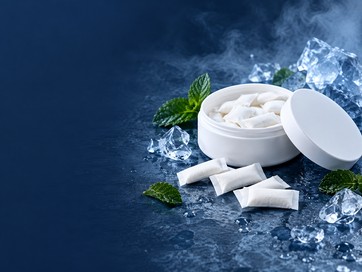
Traditional snus is sold loose, as a pinch the user forms, or in ready portions. Portions are what most people mean now. The bag is a thin non-woven fabric.
Size names describe the bag, not the nicotine. Regular or original is the fuller pouch. Slim is narrower so it sits flatter under the lip. A long cut is a longer portion. A slim bag can still be a high dose if the filling is strong. The format line on the card has to be read next to the milligrams, not instead of them.
Moisture is a second axis. An original portion is moist, so nicotine moves sooner and the bag can drip. A white portion is dry on the outside and moist inside, so it runs less and often lasts longer in the lip. A dry white is drier still, and the effect comes on more slowly. Those are traditional snus terms. Tobacco-free pouches have their own moisture and format names. On Snupax the card says slim, mini, or another format in plain text. If the format is missing, the portion size is a guess.
Nicotine strips are a third form. A strip is not a pouch and it is not left under the lip for half an hour. The number on a strip card is the dose of that strip. The pouch rules do not transfer to it.
What is in the portion
A traditional snus portion is tobacco and water, plus salt. Commercial recipes add a humectant so the bag does not dry out, an alkaline salt that raises the pH and changes how fast nicotine is absorbed, and flavour. In Sweden the product is regulated under food law, which is why ingredient lists and factory hygiene are discussed there in food terms. That Swedish classification does not make the product a food in Germany, and it does not make it harmless.
A nicotine pouch has no tobacco leaf in the bag. The German Federal Institute for Risk Assessment (BfR), in opinion No. 023/2022 of 7 October 2022, describes these products as tobacco-free, with a powder of nicotine salts and carrier materials, plus flavour. The nicotine is usually extracted from tobacco and then added. The bag looks clean because the filling is pale.
Read the card, not the colour. "White" on a traditional snus can means a drier tobacco portion. "All white" on a pouch usually means no tobacco in the filling. Same adjective, different product.
How it works
The portion stays under the upper lip. Nicotine crosses the oral mucosa into the blood. Saliva picks some of it up as well. That is why uptake is discussed both through the lining of the mouth and through swallowed saliva. There is a separate note on this site on whether to swallow saliva from a nicotine pouch. Do not swallow the bag.
Nothing burns, so the portion does not produce tar or carbon monoxide from smoke. That is the difference from a cigarette. Nicotine still reaches the blood, still acts on the nervous system, and still causes dependence.
How fast it feels depends on dose, moisture, and pH. A wetter, more alkaline portion tends to come on faster. A drier one tends to come on slower. Flavour does not change the milligrams. Mint does not make a strong portion mild.
Nicotine strength
Two numbers matter: milligrams per gram of filling, and milligrams in the single portion. One without the other is half a label.
Milligrams per gram is the concentration in the filling. Milligrams per pouch is how much nicotine is in that one portion. The second figure is concentration times portion weight. A heavy pouch at a modest mg/g can match a lighter pouch at a higher mg/g. Sorting products by only one of the two numbers sorts the pouch weight in with the dose.
On 9 October 2026 the Snupax pouch catalogue, among products with a numeric mg/g value, ran from 4 mg/g to 70 mg/g. Milligrams per pouch on those cards ran from 1.5 mg to 43 mg. A large group of cards sits at 16 mg/g, and another large group at 50 mg/g. Those are catalogue counts for that day, not a recommended dose and not a promise that the same spread will be in stock next week.
Labels such as light, normal, strong, or extra strong are brand words. They are not a shared scale. A "strong" can from one maker can sit next to a "normal" can from another with a similar portion. The Snupax card prints the two milligram figures. Use those.
There is no beginner dose on this page. The BfR advises people who do not use nicotine, and adolescents and children, not to start, because nicotine is addictive. A lower number is still nicotine. It is the wrong can for someone who has never used it.
Effects and side effects
Nicotine binds to nicotinic acetylcholine receptors and releases neurotransmitters. A portion can feel alerting or calming, and the next one is wanted. Dependence has a second half that is situational: the same desk, the same drive, the same break becomes the cue. The cue then asks for nicotine even before the bag is opened.
Short-term effects that users report, and that belong in any honest description, include a burn or tingle under the lip, more saliva, hiccups, nausea, dizziness, and a racing heart. If that happens, the portion comes out. A second pouch straight after, because the first tasted like fruit, adds the dose. Fruit does not cancel milligrams.
The gum under a pouch can get irritated. A portion left in one spot for a long time makes that more likely. This page is not a dental guide. Ongoing soreness, recession, or a sore that does not heal belongs with a dentist or a doctor, not with a higher or lower can.
The BfR writes that at least half of the nicotine in a pouch can be absorbed, and that measured blood levels sat in a range also reached after cigarettes. With highly dosed products, blood levels were clearly higher than after a cigarette. A single strong portion is therefore not a symbolic amount, even if it is the only one that day.
Is snus harmful?
Cigarettes are the high end of that comparison. The BfR cites a scale of about 127,000 premature deaths a year in Germany from cigarette smoking, with the calculation method named in the opinion. Most of the carcinogens in cigarette smoke are produced by burning. Snus and a pouch are not burned, so they do not deliver that smoke mixture.
The same opinion ranks Swedish tobacco snus as clearly less dangerous than the cigarette and, at the same time, riskier than not using nicotine at all. White pouches contain no tobacco and sit closer to other nicotine products without combustion. The institute's condition for any switch is that the person should not absorb more nicotine than from the products they used before. High mg/g pouches are where that condition fails.
Tobacco snus still contains tobacco-specific nitrosamines, even when the tobacco was heat-treated. A lower level than in some other oral tobaccos is not zero. Pouches avoid the tobacco leaf and therefore that tobacco chemistry, and they keep the nicotine. Long-term data on the highly dosed white pouches now on sale are thinner than the data on Swedish snus or on cigarettes. "No smoke" is not a synonym for "no effect".
The BfR names groups who should not use these products: children and adolescents, people who do not already use nicotine, pregnant and breastfeeding women, and people with cardiovascular disease. Nicotine passes into breast milk and acts on the heart and circulation. The opinion does not publish a harmless number of portions per day.
Is snus a drug?
In ordinary speech "drug" often means an illegal intoxicant. Nicotine does not fit that picture. It is not a hallucinogen. A portion does not work like alcohol or like cannabis.
Pharmacologically the active substance is nicotine, a stimulant. It changes nervous-system signalling and it causes dependence. That is true of a cigarette, of traditional snus, and of a tobacco-free pouch. The bag type does not change the substance. On a product card the dose is what counts. For someone who has never used nicotine, there is no good reason to start.
Is snus legal in Germany?
For tobacco snus the rule is clear. Section 11 of the German Tobacco Products Act (Tabakerzeugnisgesetz) prohibits placing tobacco products for oral use on the market. That covers classic snus and products that describe themselves as chewing tobacco. The ban follows Article 17 of Directive 2014/40/EU, which the German act implements. Sweden's exception does not apply in Germany.
A tobacco-free pouch does not fall under section 11 merely because a search called it snus. The classification of those pouches is disputed, and enforcement has still been strict. For a long time Germany had no product rule written only for them, because they contain no tobacco and so sit outside the Tobacco Products Act. State authorities have treated them as novel foods. Under the Novel Food Regulation, a novel food may be sold only if it is authorised and listed. There is no such authorisation for nicotine pouches. The BfR's 2022 opinion states that state authorities classify the pouches as novel foods and remove them from the market where they exceed the acute reference dose for nicotine. Later district orders have repeated prohibitions on sale. This is a description of that public record, not advice for a particular order, a particular district, or a particular person.
Private legal questions depend on the facts. This section does not answer them. Anyone handling these products as a business needs advice that goes beyond a guide.
How a pouch is used
Open the can, take one portion with dry fingers, place it under the upper lip, leave it there, then take it out and put it in the residual waste. Do not chew it and do not swallow it. About 20 to 30 minutes is the usual time people leave a portion in. Catalogue cards do not print a binding manufacturer clock. The first part of that time tastes strongest. Take it out if it burns, if you feel sick, or if your heart races.
Do not leave the can where a child can open it. The BfR says nicotine pouches have to be kept out of children's reach. The same applies to anyone who is not using the product on purpose. A high-dose can is not a trial size.
Strips follow the instructions on their own product page. Do not treat a strip as a small pouch, and do not treat a pouch dose as if it were a strip.
What Snupax sells
Snupax sells tobacco-free nicotine pouches, nicotine strips, and supplements. It does not sell traditional tobacco snus. The English homepage states that limit, and the product cards are pouches and strips, not brown oral tobacco.
Shipping on that homepage is with GLS and UPS to European countries, including Germany. Delivery is usually 2 to 7 working days. Orders placed before 11:00 GMT+2 leave the warehouse the same working day. Shipping is free from a basket of €90. After registration, new customers get 15 percent off the first order. Nicotine products are limited to people aged 18 and over. Stock and prices move. The card on the day you order is the one that counts, not this page.
See nicotine pouches at Snupax
Check strengths on the product cards
Sources
Catalogue spans for mg/g and mg per pouch were read from the Snupax pouch category on 9 October 2026. Shipping lines were read from the homepage the same day. Both can change.
- Snupax, English homepage. Operator named on the page: Admeris Europa OÜ, Peterburi tee 81, Tallinn, info@snupax.com. Tobacco-free nicotine pouches, strips, and supplements. No traditional tobacco snus. Age limit 18. GLS and UPS, free shipping from €90, same working day if the order is in before 11:00 GMT+2.
- Section 11 of the German Tobacco Products Act, ban on tobacco products for oral use.
- Directive 2014/40/EU, Article 17, prohibition of tobacco for oral use, with the Swedish exception.
- BfR, opinion No. 023/2022 of 7 October 2022 on nicotine pouches: composition, absorption, risk groups, and the novel-food enforcement described by the institute.