


Date: 18 October 2026
Reading time: 8 minutes
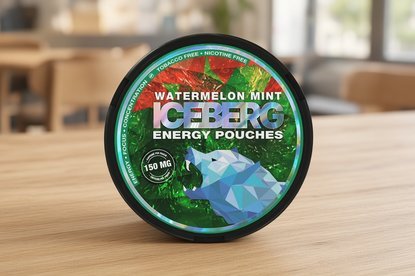
The same can may show Energy beside a printed caffeine figure. Nicotine-free on the rim is a different line.
A caffeine pouch sits under the upper lip and releases caffeine. Online, that format is sometimes nicknamed energy snus, but the nickname does not lock in one recipe. Some contain caffeine and no nicotine. Others are nicotine pouches whose flavour is called Energy. The ingredient list and the milligrams printed on each one are what tell them apart.
Contents
- Caffeine pouch, nicotine pouch or snus?
- What the label needs to answer
- What is known about absorption
- Count caffeine from every source
- What Energy means on Snupax cards
- Effects, sleep and regular use
- EU labels and the position in Germany
- A short label check
Caffeine pouch, nicotine pouch or snus?
Those three names do not point to one object. Traditional snus contains tobacco and is placed in the mouth. A nicotine pouch leaves the leaf out and still supplies nicotine. A caffeine pouch is built to release caffeine from a small oral portion. Snus and nicotine pouches are compared at more length in what snus is.
Energy is the word that causes the mix-up. It might mean caffeine, an energy-drink flavour or only a product line. It does not name an ingredient. A lightning bolt on the front does not answer the question either. Unless the packet lists caffeine and states the milligrams, the artwork cannot mark the portion as caffeinated.
A caffeine portion is not automatically free of nicotine. Recipes differ, and only the label shows whether nicotine is in there too.
What the label needs to answer
Begin with the active ingredients. Search for caffeine and nicotine on separate lines. Guarana and some other plants also supply caffeine, so read the ingredient list next to the declared milligrams.
For caffeine, the figure that helps is milligrams in one portion. If the packet quotes only a daily serving, count how many portions that serving includes. Eighty milligrams a day is one quantity in a single portion and another quantity when the serving is two. Follow the suggested use as a limit, not a goal.
Nicotine is counted on its own scale. A card may list milligrams per gram and milligrams in each portion. Neither number measures caffeine. If both substances are present, each one needs its own line. Where the page or the packet stays silent, do not borrow the missing figure from the flavour name.
What is known about absorption
Caffeine can pass through the lining of the mouth. The stronger claim, that a portion sends every milligram straight into the blood, is too tidy. People swallow saliva. Dissolved caffeine can then reach the stomach and the intestine, not only the oral mucosa.
A study of caffeinated chewing gum points the same way. After the gum was chewed, the study recorded two plasma peaks. That pattern fits an early uptake through the mouth and a later pass through the gut. Release changed with chewing time, and it differed between participants. Gum is not the same object as a finished caffeine portion, so the study cannot promise a start time for every pouch.
There is a practical limit. A manufacturer may print its own release test or its own onset claim. The next packet may differ in moisture, pH, the chemical form of the caffeine and the material of the portion. “Works in five minutes” is not true of the whole category. The stomach is not fully bypassed either.
Count caffeine from every source
The European Food Safety Authority, EFSA, looks at caffeine across the whole diet, not at one product in isolation. In healthy adults, single doses up to 200 mg did not raise a safety concern. Neither did intakes up to 400 mg spread across a day. Those figures are a population assessment. They are not advice to aim for 400 mg. They do not clear someone who is ill.
Everyday drinks already add up. EFSA’s rough examples put 90 mg in 200 ml of filter coffee and 80 mg in a 60 ml espresso. A 250 ml energy drink is about 80 mg. Black tea is about 50 mg in 220 ml, and a 355 ml cola is about 40 mg. Brands and cup sizes differ.
A pouch belongs in that same daily sum, beside coffee, tea, cola, energy drinks and caffeine supplements. EFSA did not study caffeine taken together with medicines. Questions about a medicine belong with a pharmacist.
The clock matters as well as the sum. EFSA notes that 100 mg, taken near bedtime, may shorten sleep or change its pattern in some adults. A dry portion that carries 100 mg is still a 100 mg dose.
What Energy means on Snupax cards
On the live Snupax cards below, Energy is filled in as the flavour. Each card names a nicotine pouch and prints nicotine figures. None of the three prints a caffeine quantity. The word on the can does not measure caffeine.
| Card | Nicotine mg/g | Nicotine mg/pouch | Pouch | In the can | Caffeine amount on card | Price, one / from 10 |
|---|---|---|---|---|---|---|
| GARANT Energy drink | 20 | 10 | 0.5 g | 27 | Not published | €3.61 / €2.98 |
| CUBA NINJA Energy | 30 | 15.6 | 0.52 g | 25 | Not published | €3.61 / €2.98 |
| Iceberg Energy | 50 | 40 | 0.8 g | 20 | Not published | €3.97 / €3.29 |
Card details and prices checked on 17 October 2026. “Not published” means the Snupax card does not publish a caffeine amount.
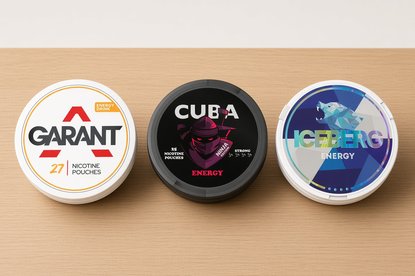
GARANT Energy drink, CUBA NINJA Energy and Iceberg Energy. On these three Snupax cans, Energy names the flavour.
Effects, sleep and regular use
Caffeine stimulates the central nervous system. It can sharpen alertness or cut sleepiness. It can also bring restlessness, tremor, anxiety, a racing heartbeat or broken sleep, more so as the dose climbs or in someone sensitive to it. A small portion does not cancel those effects.
With steady use, the familiar dose can feel milder. That fading is tolerance. Stopping after regular intake can bring headache, tiredness, irritability or trouble concentrating. Taking a larger dose to chase the old feeling is a weak stand-in for adding up the day’s total.
In pregnancy the EFSA figure drops. Up to 200 mg a day from every dietary source is the intake that did not raise concern for the fetus. Where caffeine is added to a food for a physiological purpose, EU labels warn that it is not recommended for children or pregnant women. Someone with an illness, or anyone taking medicine, should ask a clinician or a pharmacist. A population figure is not personal advice.
Severe restlessness needs urgent medical help. So does nausea together with a fast or irregular heartbeat, and so does any other alarming symptom after caffeine. If too much may have been taken, call emergency services or a poison centre. Keep the packet. The clinician or the poison service needs the ingredients and the stated amount.
EU labels and the position in Germany
Calling a caffeine pouch “snus” does not settle whether it is lawful. The formula, the way it is presented and the intended use decide which rules apply. Leaving tobacco out does not leave the rules out.
Under Annex III of Regulation (EU) No 1169/2011, a food other than a beverage with caffeine added for a physiological purpose must carry the statement “Contains caffeine. Not recommended for children or pregnant women.” The caffeine quantity must also be declared in the prescribed form. Guarana does not erase that duty when it is added for the caffeine it provides.
Germany’s Federal Office of Consumer Protection and Food Safety, BVL, treats food supplements as foods, not as medicines. Before a supplement is first marketed in Germany, the manufacturer or importer must notify BVL. That notice is not an approval, and it does not show that the product meets every food-law requirement. The business stays responsible. State authorities carry out enforcement.
“Completely legal in Germany” is too broad until one particular packet has been checked. Look at classification, ingredients, claims, warnings and any novel-food question. For a single item, read the label and ask the German food-control authority that handles it.
A short label check
- Find caffeine on the ingredient list and read the milligrams per portion or per recommended daily serving.
- Look separately for nicotine. Energy does not declare an active ingredient.
- Add the portion to the coffee, tea, cola, energy drinks and supplements taken that day. Ask a pharmacist how to count caffeine that sits in a medicine.
- Read the suggested amount and the warnings. A population ceiling is not a daily target.
- Do not treat five minutes as a universal start time or assume one fixed duration. The recipe and the person both change the result.
- If the card never states the figure you need, do not invent it.
Sources used
- European Food Safety Authority: Caffeine
- German Federal Institute for Risk Assessment: Caffeine FAQ
- PubMed: Caffeine release and absorption from caffeinated gums
- EUR-Lex: consolidated Regulation (EU) No 1169/2011
- BVL: food-law and food-supplement FAQ
The button opens the Garant range of nicotine pouches. It does not point to caffeine portions.